Source code · Mac app tour · Feature documentation
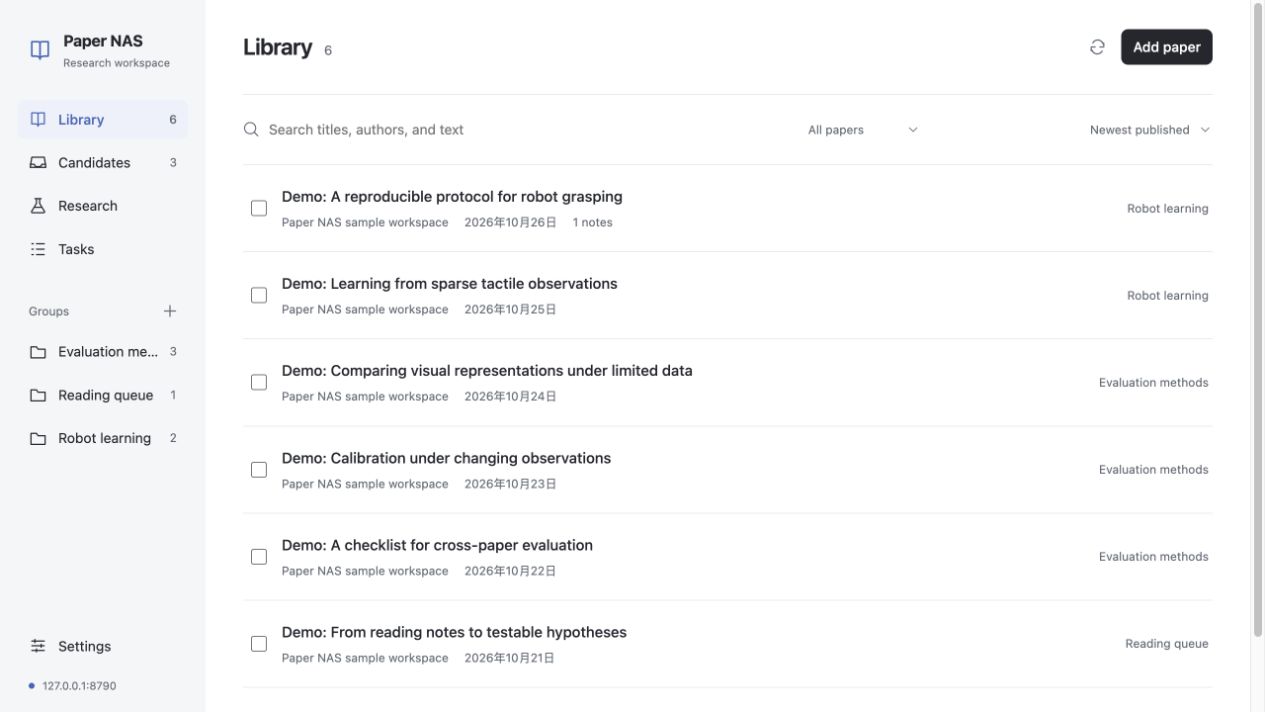
PaperNAS brings paper reading and research records into one personal workspace. A native Mac application and a browser client connect to a library hosted on a NAS, home server, or local machine. The central idea is to keep the path from an original paper to an interpretation inspectable: documents, notes, evidence, and subsequent judgments remain connected.
Library and import
The library accepts PDFs, paper URLs, DOIs, and arXiv identifiers. Bounded searches of arXiv and Crossref collect candidates into a separate queue, where the reader decides what to import. Groups, search, filters, and batch organization support a reading workflow without treating every discovered item as part of the permanent library.
Import and document processing run as durable server tasks. Their progress can be inspected, and operations can be paused, resumed, cancelled, or retried. Work can continue while the browser or Mac client is closed.
Reading and source evidence
Readers can move between original PDF pages, extracted text, figures, notes, and saved analyses. Notes retain a document version and page. The Mac client supports PDF text selections and rectangular anchors; the browser uses explicit page and quotation fields. Figures retain their source page, and extraction regions can be corrected through the application.
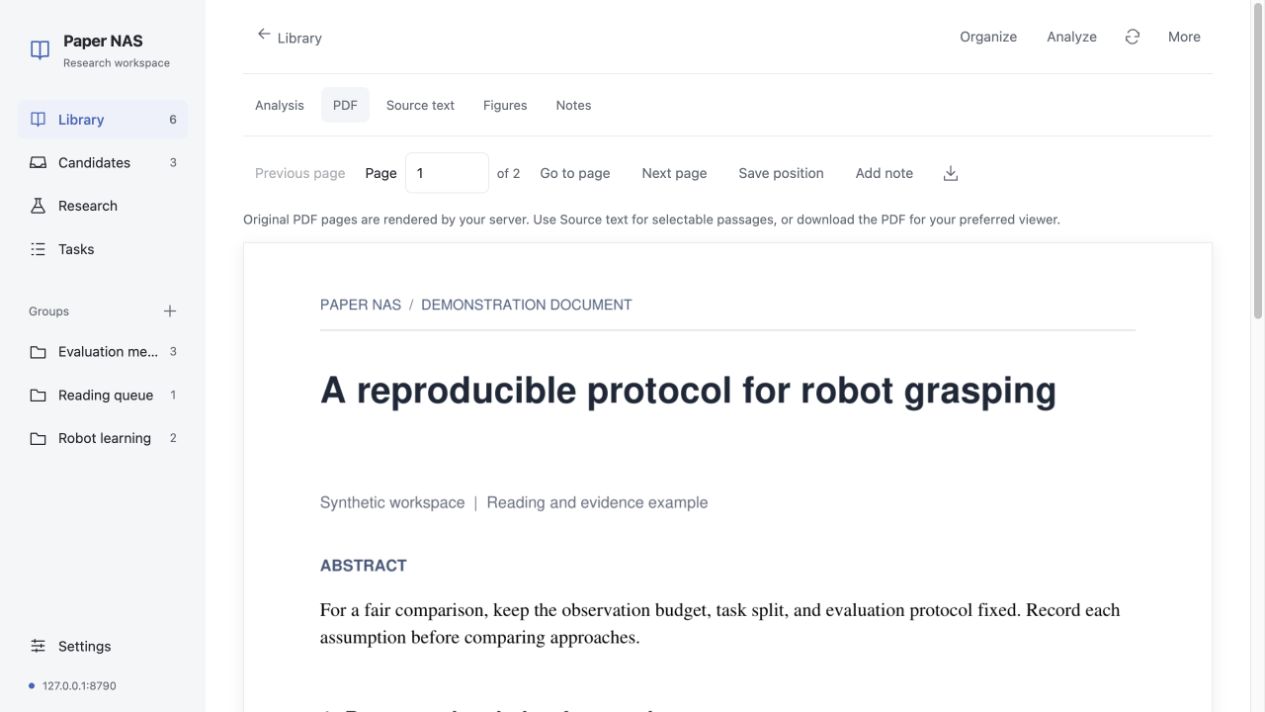

Passages and figures can be saved as evidence for a research question. Each evidence record preserves its original source anchor, so a later reparse or figure correction does not silently replace the material behind an earlier observation.
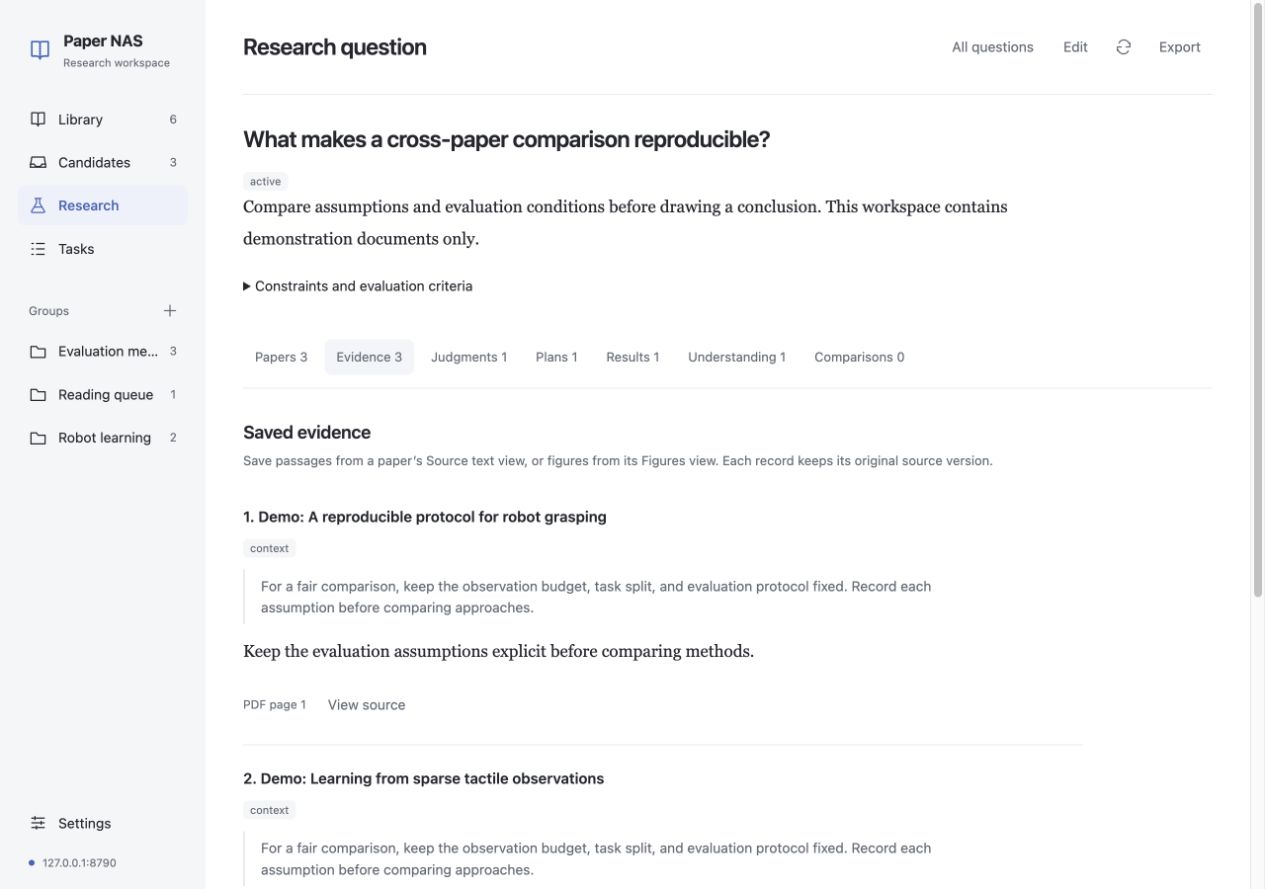

Questions, judgments, and plans
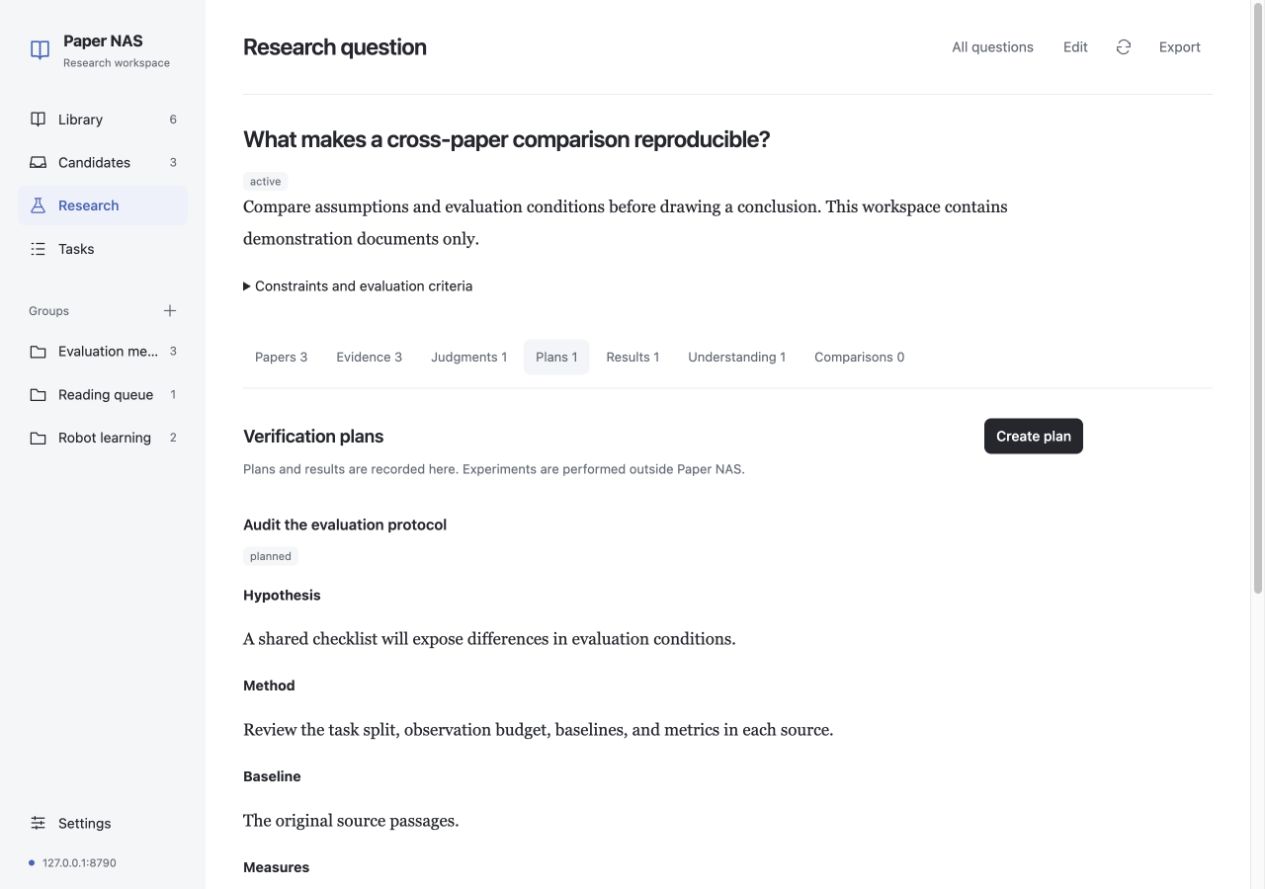
The research workspace connects collected evidence to revisable judgments. Verification plans record a hypothesis, method, baseline, measures, success criteria, stopping conditions, and a budget. Results from work performed outside the application can then be recorded alongside snapshots of the reader’s evolving understanding.
This makes the reasoning and its history available for later review. PaperNAS records plans and results; it does not execute experiments. Research records can be exported as Markdown or JSON, alongside exports of analyses, original PDFs, and figures.

Optional analysis
Reading, notes, and research records work without a model provider. When enabled, paper analysis and cross-paper comparison send bounded source excerpts to a configured OpenAI-compatible provider. The server retains responses and validates cited quotations against the supplied text before publishing an analysis.
These checks establish where a quotation came from; they do not establish scientific correctness or guarantee complete paper coverage. Source links let the reader return to the original passage and assess the interpretation directly.
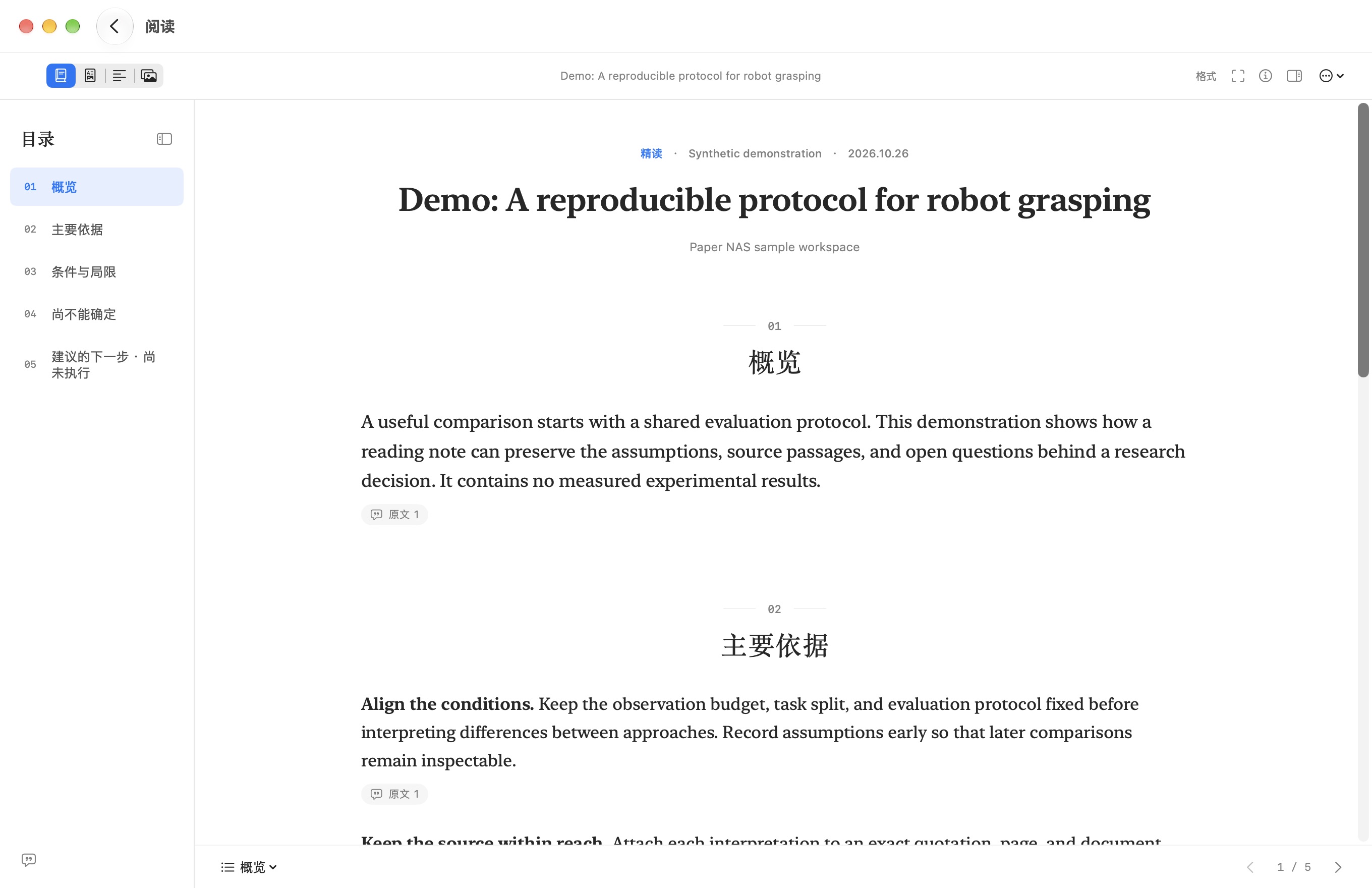

Native Mac and web clients
The Mac application uses SwiftUI and PDFKit, with local KaTeX rendering for mathematical text. The browser uses plain JavaScript modules and CSS, including responsive layouts and light and dark appearances. Both clients share a FastAPI backend: PostgreSQL stores library records, revisions, and the task queue, while content-addressed files retain documents and derived assets.
PaperNAS remains an early-release, single-user workspace shared across authorized devices. The current version does not implement semantic search, Zotero synchronization, or scanned-document OCR.
All screenshots show the running application on October 26, 2026, using synthetic demonstration papers and research records. They illustrate the interface and workflow, not published research or measured experimental results.